Santiago de Compostela is one of those cities that has a little bit of everything. In northwestern Spain, Santiago is best known as the end of the famous Camino de Santiago pilgrimage. However, there is much more to the city than its cathedral and the thousands of pilgrims who arrive here every year. The historic center is full of beautiful stone buildings, narrow streets, traditional restaurants, and charming squares. You can spend hours walking around the old town, discovering its architecture, trying traditional Galician food, or enjoying a coffee in one of its many cafés. This part is actually not so different than many of the smaller towns and cities across Spain. If you remember, I also talked about a similar center for Almeria or Jaén.
What makes Santiago de Compostela a little different is everything you can explore beyond the city itself. If you have a few extra days, you can use it as a base for discovering Galicia, visiting smaller towns, exploring the Atlantic coast, or trying some outdoor activities. Whether you are visiting for a day or planning a longer trip around northern Spain in the cities of Galicia, this Santiago de Compostela travel guide covers the best things to see and do, what to eat, where to stay, and how to make the most of your visit.
Disclaimer: I used AI support to generate some image designs in this blog post.
Why Santiago de Compostela?
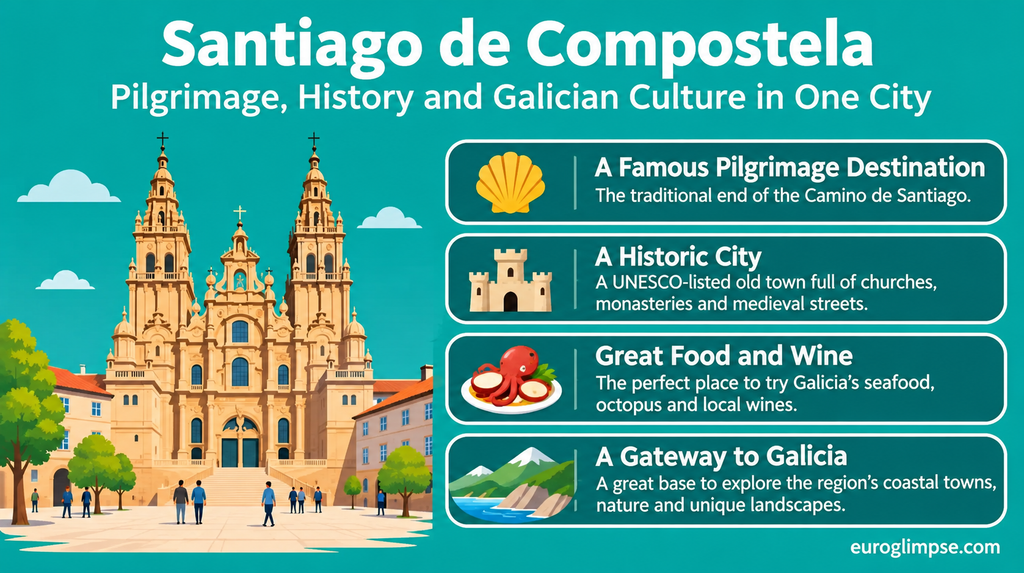
Santiago de Compostela is the capital of Galicia, an autonomous community in northwestern Spain. It is one of the country’s most important historical and cultural destinations, known for its architecture, religious heritage, and traditional Galician culture. The city’s biggest attraction is the Cathedral of Santiago de Compostela. It’s the traditional end of the Camino de Santiago, a network of pilgrimage routes that have brought travelers from across Europe to the city for centuries. If you are lucky and stay in downtown Santiago for a few days at the right time, you can see pilgrims arrive at Praza do Obradoiro.
The historic center is recognized as a UNESCO World Heritage Site because of the history and how well those churches, monasteries, old stone houses, and traditional squares are preserved. Most of the main attractions are close, so you can just walk the entire thing. Food is also a big part of the experience. Galicia is known for its seafood, octopus, traditional pies, and excellent local wines. Santiago is a particularly good place to try these specialties, as it is the capital of Galicia! And the most important thing is that Santiago is an excellent base for covering all of Galicia. It’s close to everything, and transportation routes connect through Santiago. You can visit the little fishing villages, go surfing, or see other famous landscapes like Ribeira Sacra.
Best Things to Do in Santiago de Compostela
Santiago de Compostela is kind of a town where it’s not just about visiting historical sights and the historic center. You definitely start there, but there are plenty of activities to explore and fill up your time. The more time you have, the more beautiful ground you can cover outside of Santiago but still close enough for a day trip. I’ll just list the most popular things to do in Santiago de Compostela for this Santiago de Compostela travel guide, and you can pick and choose for your own itinerary.
Visit the Cathedral of Santiago de Compostela and Praza de Obradoiro
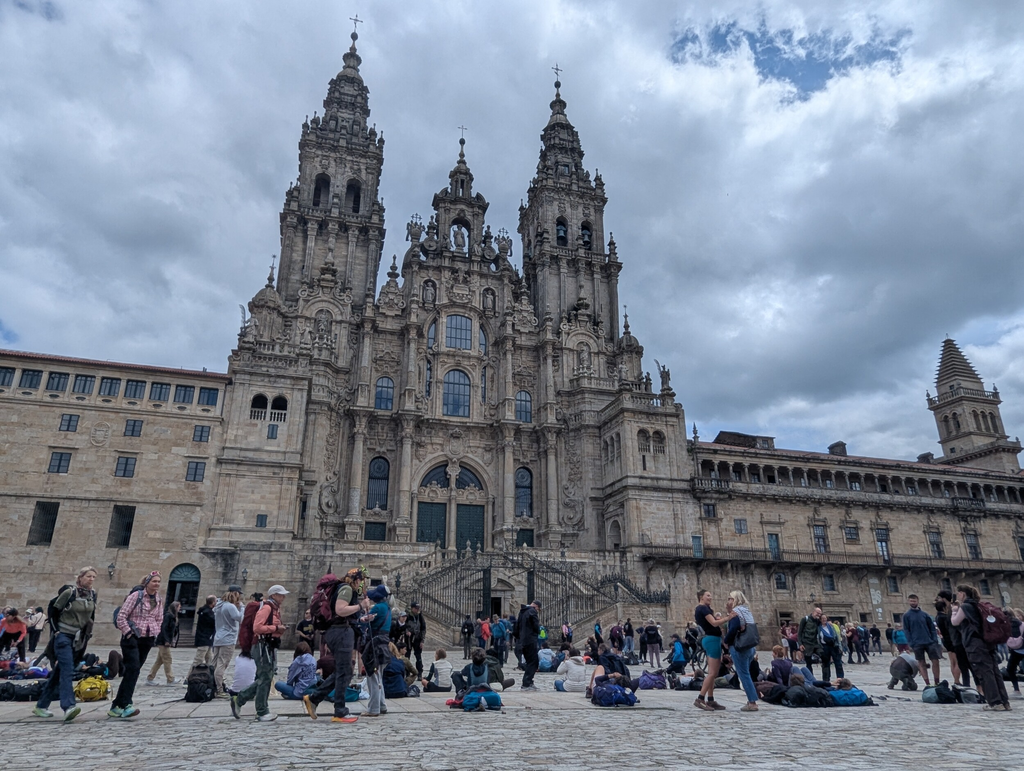
No Santiago de Compostela travel guide is complete without talking about The Cathedral of Santiago de Compostela. This cathedral is the traditional burial place of Saint James the Apostle and the final destination of the Camino de Santiago pilgrimage, and Praza de Obradoiro is right in front of the cathedral. This is one of the main destinations everybody who goes to Santiago visits. It is an impressive example of Romanesque architecture, even though centuries of additions and renovations have given it elements of several other styles. You can enter the cathedral and explore its interior for free, including the main nave, chapels, and the area of Saint James’s tomb. Before visiting, check the official Cathedral visitor information for current opening hours, access restrictions, and available visits. You can also book tickets for the Cathedral Museum, Pórtico de la Gloria, and rooftop tours online.
If history is your thing, I suggest visiting the Cathedral Museum while you are there. It walks you through the cathedral’s history very well. You have to pay either separately for the museum or, depending on the ticket you buy, you may also visit the Pórtico de la Gloria and join a guided tour of the cathedral rooftops.
And Praza do Obradoiro is also one of the most recognizable places in Santiago. Apart from the cathedral, there are many important buildings surrounding the square. Some are Hostal dos Reis Católicos, the Pazo de Raxoi and the Colegio de San Xerome. Each building has a different architectural style, which makes the square interesting to walk around.
Wander Through the Old Town
One of the best things to do in Santiago de Compostela is simply walk around the historic center without following a strict itinerary. The old town is full of narrow stone streets, traditional buildings, small shops and beautiful squares. You will come across historic churches, hidden courtyards and old arcades almost everywhere you go. Some nice streets are Rúa do Franco, Rúa do Vilar, and Rúa Nova. Rúa do Franco is particularly well known for its restaurants and tapas bars, and Rúa do Vilar and Rúa Nova are great for their traditional architecture. The historic center is relatively compact, and you can easily spend a few hours walking around, taking photographs and stopping for something to eat or drink.
Visit Mercado de Abastos
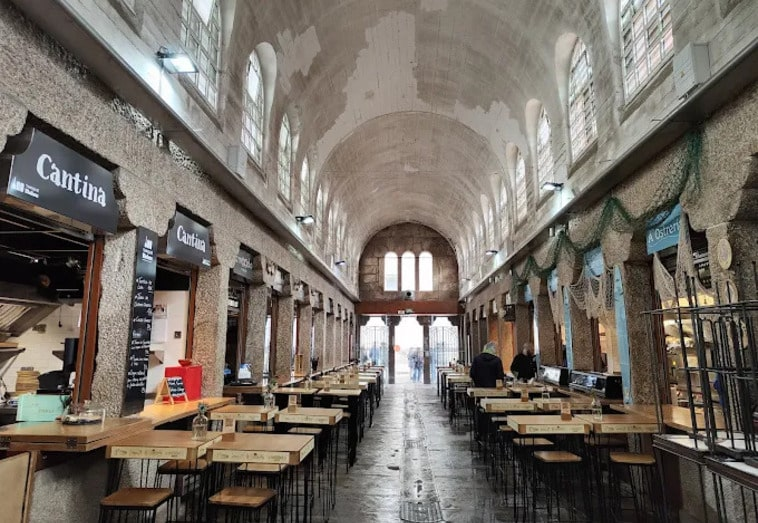
If you want to experience local food culture, Mercado de Abastos is one of the best places to visit in Santiago. I mean, in almost every Spanish town and city, you have to visit the local market. Some are more touristy than local, but even they can still be extremely good. These traditional markets have been an important part of the daily life of every city for generations, including Santiago de Compostela. You will find fresh seafood, fish, meat, cheese, vegetables, and other local products. Most of them offer small bites you can try. In every Spanish city I go to, I always end up at these markets and try a different small bite. Usually fish, but it’s your call. There is also an area dedicated to food and restaurants, where you can stop for a meal or try some local specialties. The market is generally busiest in the morning, particularly on Thursdays and Saturdays. It is usually open Monday to Saturday, with Sundays and certain public holidays as exceptions. Check the official market website for current information.
Discover Praza da Quintana
Praza da Quintana is another beautiful square located just behind the cathedral. It is one of the most atmospheric places in the historic center. The square is divided into two levels, known as Quintana de Vivos and Quintana de Mortos. The lower section was historically used as a burial ground, and the upper section served as a gathering place. One of the most recognizable buildings here is the cathedral’s eastern façade. You can also see the Holy Door, which is opened during Holy Years of Santiago.
Enjoy the Views from Alameda Park
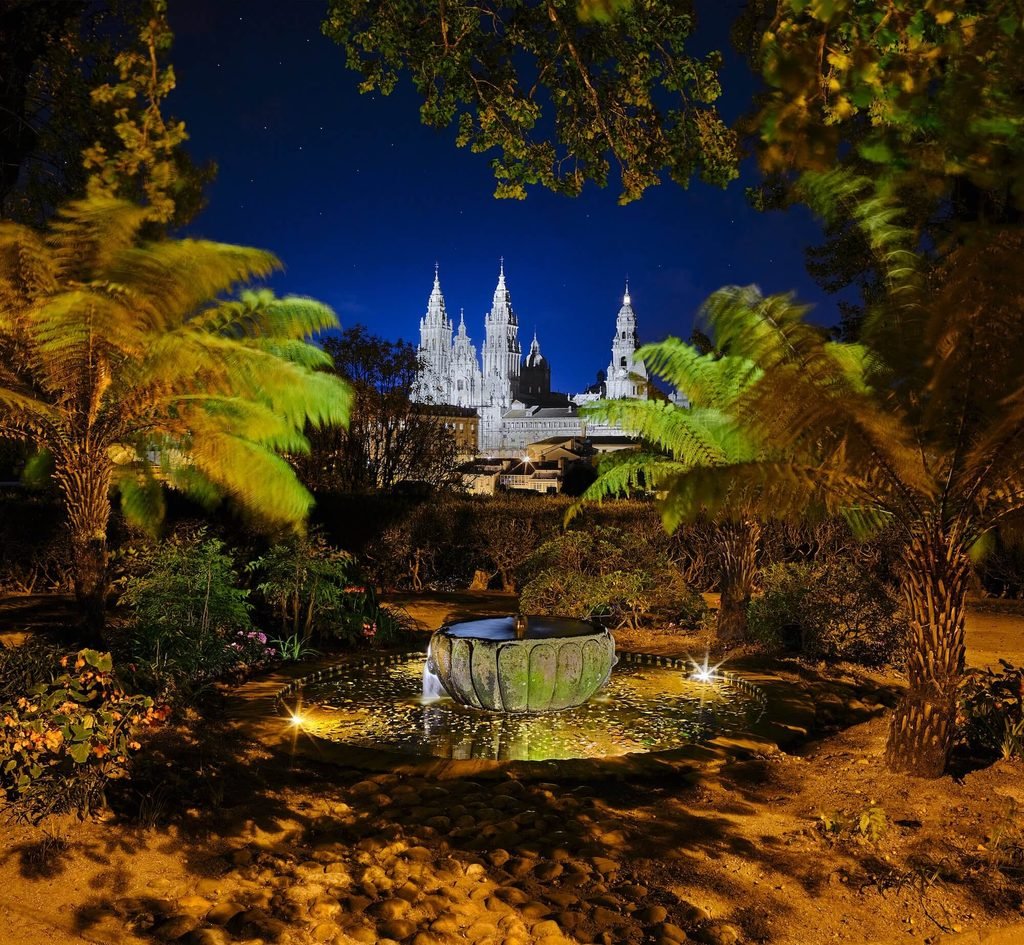
You can perhaps finish these in half a day if you finish early. If you want to take a break from the busy historic center, have a nice lunch in green areas, and head to Alameda Park. It’s right outside the old town, and it’s a large green space. You can walk there easily in good weather. It has tree-lined paths, gardens, statues, and several viewpoints overlooking the historic center. The best-known viewpoint is along Paseo da Ferradura, where you can enjoy one of the classic views of the cathedral. Alameda is also a good place to visit if you want to see a different side of the city. You will find locals walking, exercising, or simply enjoying the green space.
Visit the Monastery of San Martiño Pinario
This is also close to the main cathedral but can be a good stop after lunch if you can’t fit it in before. The Monastery of San Martiño Pinario is one of the most impressive historic buildings in Santiago. The monastery has a long religious history and is particularly interesting for its size and architecture. Its large stone façade and richly decorated interior are quite interesting, even to someone who doesn’t understand art much.
Depending on the current visitor arrangements, you may be able to explore parts of the former monastery, including its church and historic rooms. It is an easy addition to your sightseeing route, especially if you are already visiting the cathedral and Praza da Quintana.
Discover the Museum of the Galician People
If you want to understand more about Galicia beyond its famous food and landscapes, the Museum of the Galician People, known locally as Museo do Pobo Galego, is your place to go. It’s an interesting place with exhibitions that cover different aspects of Galician history, culture, and traditions, including fishing, agriculture, clothing, and so on. The museum is in the former Convent of Santo Domingo de Bonaval. One of the most interesting features of the building is its famous triple spiral staircase.
What to Eat in Santiago de Compostela
Spain is famous for its food, and each region has a different specialty. To outsiders, it looks like it’s mostly seafood and similar stuff, but it’s actually not. Galician dishes are quite traditional and can be very different than what you find in down South. I can recommend some of these:
- Pulpo a feira: Galician-style octopus is probably one of the region’s most famous dishes. The octopus is boiled until tender and traditionally served with olive oil, paprika, and salt, often with boiled potatoes.
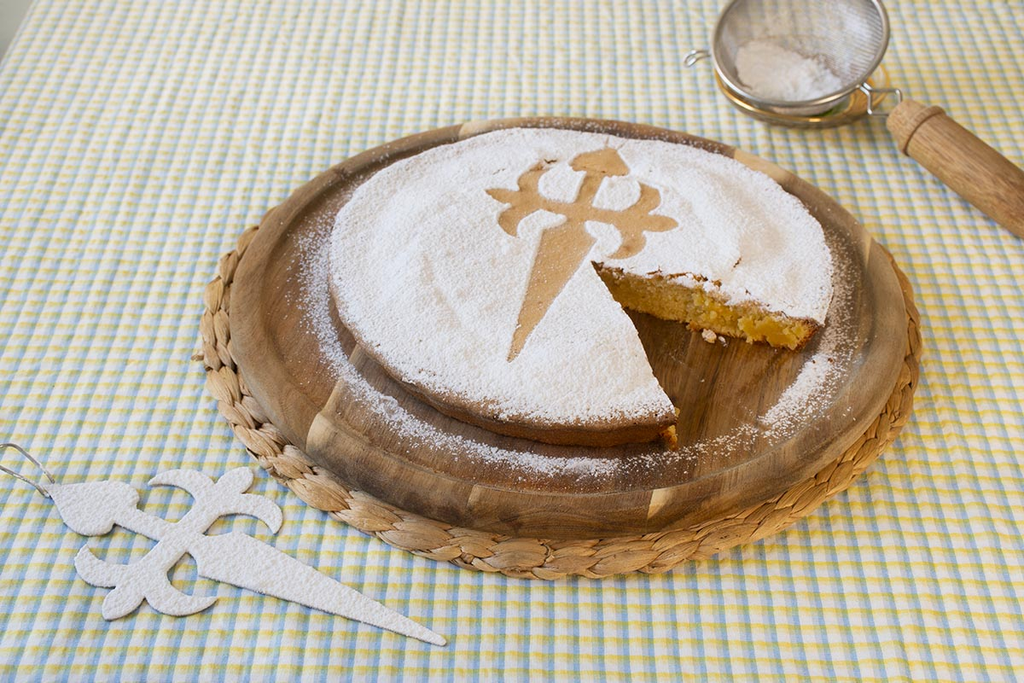
- Tarta de Santiago: You cannot leave Santiago without trying its famous almond cake. Tarta de Santiago is a traditional dessert made mainly with almonds, sugar and eggs. It is usually decorated with a powdered sugar image of the Cross of Saint James.
- Pimientos de Padrón: These small green peppers come from the town of Padrón, not far from Santiago. They are usually fried in olive oil and served with coarse salt. There is a popular saying about them: some are spicy, while others are not.
- Caldo gallego: If you visit during the colder months, try caldo gallego. This traditional soup is made with ingredients such as potatoes, beans, greens, and pork products. It is a filling and warming dish that has been part of Galician cooking for generations.
How Many Days Do You Need in Santiago de Compostela?
This is a million-dollar question because it’s different for every purpose and there is no Santiago de Compostela travel guide that can answer this question on behalf of you. It all depends on your preference. For most visitors, one or two days are enough to see the main attractions in Santiago de Compostela and cover good ground. The historic center is relatively compact, and you can visit the cathedral, explore the old town, and enjoy some traditional Galician food without rushing too much. If you only have one day, you can still see the main highlights. However, you will need to prioritize the attractions you are most interested in. But none of this covers the extra stuff Santiago can offer, such as the activities, great hiking opportunities, day trips for surfing, or seeing the small towns around it.
I would recommend spending three days in Santiago. This gives you enough time to explore the historic center, visit museums, and enjoy the food scene without running everywhere. You may be able to fit in a day trip, too. My best recommendation is five to seven days, though. You can use Santiago as a base and explore the Galicia region. You can take day trips to the Atlantic coast, visit nearby cities, and see some of the region’s most beautiful natural areas.
Santiago de Compostela Itinerary Examples
How much time you have in Santiago will determine what you can realistically see and how much you can enjoy the city. Since I am talking about a broad Santiago de Compostela travel guide, I curated broad example itineraries based on how many days you may have. One, three, and seven days. Obviously, these are examples, and you can pick and choose. Their goal is to give you an idea of what a Santiago de Compostela itinerary can look like.
One Day in Santiago de Compostela
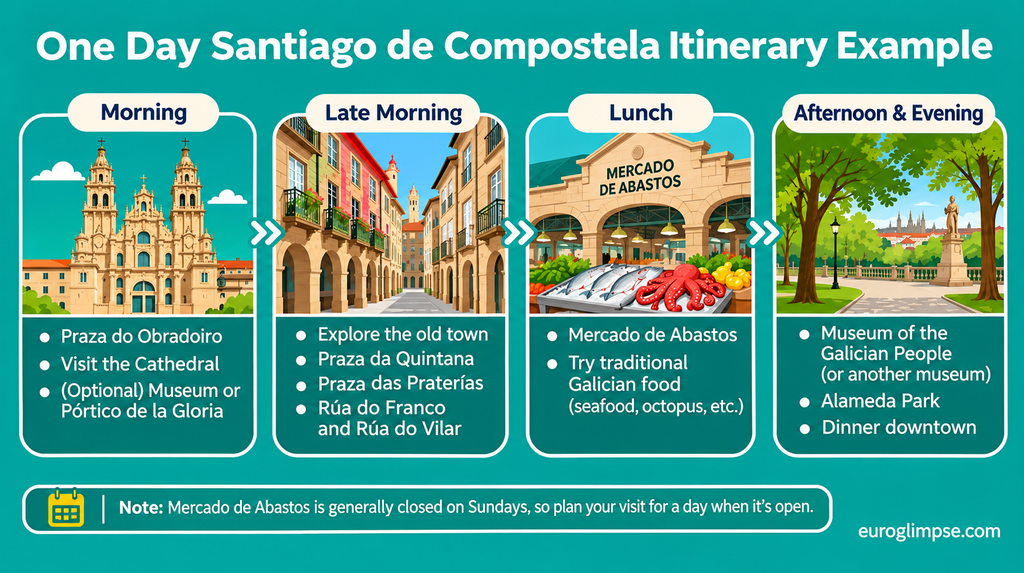
If you only have one day in Santiago, focus on the historic center. Most of the main attractions are within walking distance, and you do not need to use public transport. Praza do Obradoiro is in the center, so start your day there and see it from the oth outside and inside. If you are interested in the cathedral’s history, you can reserve an entry to the Pórtico de la Gloria or the museum in advance. From there, walk around the nearby squares, including Praza da Quintana and Praza das Praterías. You can then explore the narrow streets of the old town, particularly Rúa do Franco and Rúa do Vilar.
For lunch, definitely go to Mercado de Abastos and try some traditional Galician food. Remember that the market is generally closed on Sundays, so go on a day that’s open (check it on Google beforehand; it’s quite up to date). In the afternoon, visit the Museum of the Galician People or walk through Alameda Park (one of my favorites). Then have a nice dinner downtown.
Three Days in Santiago de Compostela
Three days give you much more time to enjoy the city without rushing. This can be a city break, maybe over a long weekend. Based on your preference, you may even be able to do a day trip.
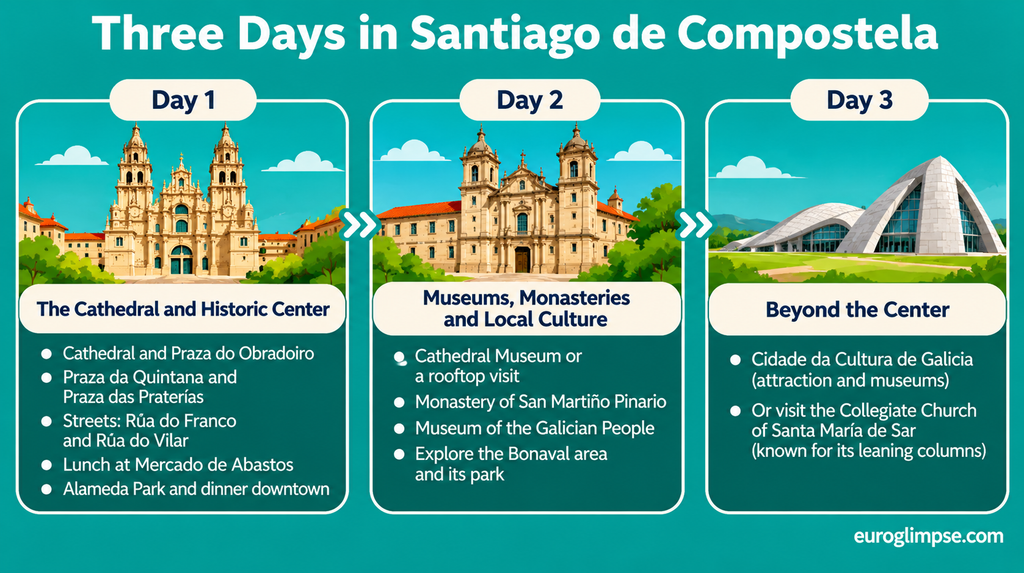
- Day 1: The Cathedral and Historic Center. Spend your first day exploring the main attractions in the old town. Cathedral of Santiago de Compostela and Praza do Obradoiro, Praza da Quintana, Praza das Praterías. Walk through the historic streets, including Rúa do Franco and Rúa do Vilar. Stop at Mercado de Abastos for lunch. In the afternoon, visit Alameda Park and finish the day with dinner in one of the local restaurants.
- Day 2: Museums, Monasteries and Local Culture. This day is to go deeper into the local culture with museums. You may skip these and maybe add a day trip if this is not your thing. Some of your options for the museum and cultural part are the Cathedral Museum or a rooftop visit if you did not have time on the first day. The Monastery of San Martiño Pinario and its historic architecture. You can also go to the Museum of the Galician People, where you can learn more about the history and traditions of Galicia. You can also explore the surrounding Bonaval area and its park.
- Day 3: Beyond the Center. If you stay in Santiago the whole three days, then you can go outside the center a little on your last day. One option is the Cidade da Cultura de Galicia, similar to the Cathedral; you can see the attraction and go to the museums around it. Another option is to visit the Collegiate Church of Santa María de Sar. Located a little outside the main tourist area, it is known for its historic architecture and leaning columns.
Seven Days in Santiago de Compostela and Galicia
If you have a full week, I would recommend spending the first few days in Santiago and then exploring the rest of Galicia. You can use Santiago as a starting point, but you don’t necessarily need to return there every evening. Depending on your plans, staying one or two nights in another part of Galicia can save you quite a bit of driving. Galicia has a lot to offer, from beautiful coastal villages and historic cities to impressive river canyons and natural landscapes. And a lot of activities.
Visiting Santiago
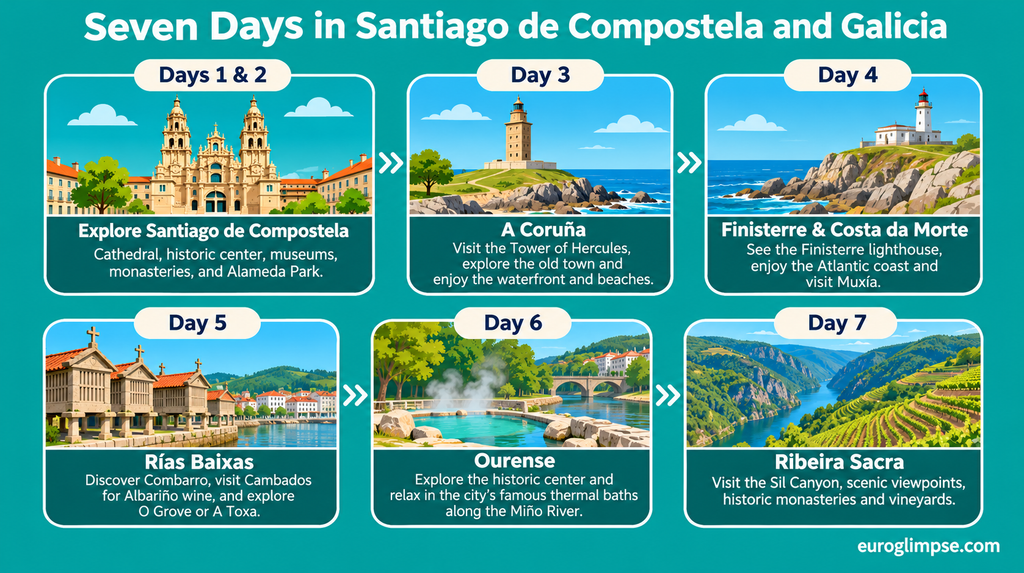
- Days 1 & 2: Explore Santiago de Compostela. Spend your first two days exploring the main center, as in the three-day itinerary. Visit the cathedral, Praza do Obradoiro, Praza da Quintana, Alameda Park, have lunch at Mercado de Abastos, and see the main streets of the old town. Take a look at the museums or some activities in Santiago based on what you prefer. Explore the Monastery of San Martiño Pinario, the Museum of the Galician People and the Collegiate Church of Santa María de Sar. You can also visit the Cidade da Cultura de Galicia.
Day trips from Santiago de Compostela
- Day 3: Visit A Coruña. A Coruña is one of the easiest cities to visit from Santiago. It is around an hour away by car, and you can also travel there by train. You can visit the Tower of Hercules, a Roman lighthouse and UNESCO World Heritage Site. Explore the old town, visit Praza de María Pita, and walk along the city’s waterfront. If the weather is good, you can also spend some time at Riazor Beach or Orzán Beach. I have an A Coruña travel guide for a more extensive look.
- Day 4: Finisterre and the Costa da Morte. For a completely different experience, definitely go to Finisterre (Fisterra in Galician). The area is famous for its Atlantic coastline and its connection to the Camino de Santiago. Finisterre was considered the end of the world in the old times, so it was the last stop for pilgrims. They still follow this route today, so many pilgrims continue their journey from Santiago to Finisterre. Visit the lighthouse at Cape Finisterre, the views are amazing. If you have enough time, you can also explore nearby Muxía, a coastal town known for its sanctuary beside the sea. This is a longer day trip, so renting a car or joining an organized tour is often the easiest option.
- Day 5: Rías Baixas. The Rías Baixas region is one of the best places to visit if you want Galicia’s coastal scenery and food culture. Start with Combarro, a traditional fishing village famous for its stone granaries along the waterfront. Afterward, visit Cambados, a town particularly famous for its Albariño wine. If you are interested in wine tourism, you can explore the Rías Baixas Wine Route, which connects local wineries, vineyards, food, and coastal destinations. Do a wine tasting! You can also continue towards O Grove or A Toxa for beautiful coastal scenery, seafood restaurants and opportunities for boat trips.
Special Areas
- Day 6: Ourense and Its Thermal Baths. Ourense is known for its historic center, Roman heritage, and thermal waters. Ourense’s most popular thing is the outdoor thermal bathing areas along the Miño River. Some of them are free, and there are some where you have to pay or reserve ahead. Usually, a good way to see Ourense is to see the city during the day and go to the river in the afternoon to relax.
- Day 7: Ribeira Sacra. For the last day, I highly recommend Ribeira Sacra. The region is famous for its deep river canyons, historic monasteries, vineyards, and beautiful viewpoints. The Sil Canyon is particularly well known for its steep slopes and vineyards built into the hillsides. This is a good place to do some hiking. That’s why it’s good if it’s on the last day, so you can spend all of your energy. I recommend renting a car to explore the region, though. You can see everything that way. Also, public transportation is not the best way to get to Ribeira Sacra.
Best Time to Visit Santiago de Compostela
Santiago de Compostela has a mild Atlantic climate, which means that the weather is generally cooler and wetter than in many other parts of Spain. You should be prepared for some rain throughout the year, even during the summer months. However, the city is worth visiting in every season. The best time depends on whether you prefer warmer weather, fewer tourists, a quieter atmosphere, or what activities you want to do. For this specific Santiago de Compostela travel guide, I’ve kept activities that you can do in each season but you should pick which one you’d like the most.
Spring
As usual in almost every place, spring is a good time to visit Santiago if you want to avoid the busiest summer months. Temperatures gradually become warmer, the surrounding countryside turns green, and the city is generally less crowded than during the main holiday season. Rain is still common, so bring a light waterproof jacket and comfortable shoes.
Summer
No surprise that summer is the busiest period, likely everywhere else. But it’s also a great season. The days are longer, temperatures are really pleasant, and there are more opportunities to explore the surrounding region. July is particularly important because the city hosts the Feast of Saint James on 25 July. There are religious celebrations, cultural events, and festivities, attracting many visitors and pilgrims. It’s a great time if you want to mix your trip with some festivals. If you plan to visit during this period, book your accommodation well in advance. Prices and demand can increase significantly around the celebrations.
Autumn
Autumn is another good option, especially if you prefer fewer tourists and don’t mind a little more rain and cloudy days than spring. September still has nice temperatures; it may still feel like summer. October and November have a bit cooler weather and more rainfall. The surrounding countryside is particularly beautiful during this season. It makes a good time to do day trips and see the broader Galicia.
Winter
Many people don’t travel in winter, but I think the charm here is different. It’s the quietest season for tourism, streets are empty, prices are lower, and temperatures are still okay if you are coming from Western or Northern Europe. You’ll just see a bit more rain and cloud than usual. Surf is also great in winter. Some attractions and businesses may have shorter opening hours, but the main historic and touristic sites don’t change. If you do not mind the weather, winter can be a good time to experience the city without the summer crowds.
How to Get to Santiago de Compostela
Santiago de Compostela is well connected to other parts of Spain, making it relatively easy to reach by plane, train or bus. It has an airport, Santiago-Rosalía de Castro Airport, about 12 kilometers away from the city center. And there is a bus that runs from the airport to the city: Line 6A. It doesn’t serve a lot of routes but serves well within Spain and some international routes. If you are outside of Spain, it may be tough to take a plane, options are quite limited.
Many people usually travel to one of the big cities by plane, like Madrid or Barcelona, and take a train to Santiago. You may even fly to A Coruña, sometimes there are more connections there. The rail connection to Santiago is quite good, and especially from Madrid, there are quite frequent trains. Same goes for the bus – you can take buses into Santiago from bigger cities, but I do not recommend it if a train is available. You can use buses to go to smaller destinations within Galicia.
Lastly, a car. Renting a car is a good option if you want to explore more of Galicia during your visit. It gives you much more flexibility when visiting places such as Finisterre, Ribeira Sacra and the smaller coastal villages. Some of these destinations are difficult to reach using public transport, particularly if you want to visit several places in one day. You do not really need a car to explore Santiago itself. In fact, the historic center has restricted vehicle access, and parking can be difficult. I would only rent a car if you plan to explore the surrounding region.
Practical Tips for Visiting Santiago de Compostela
Apart from the usual travel tips and tricks, Santiago can be a tricky place in terms of preparation. Here are some of my little thoughts that may make your trip a bit less annoying at times.
- Bring a waterproof jacket. Galicia is known for its rainy weather, and Santiago is no exception. Even during summer, it is worth carrying something waterproof.
- Wear comfortable walking shoes. The historic center has many cobbled streets and uneven stone surfaces. You will probably spend most of your time walking, so bring some adequate shoes.
- Book cathedral experiences in advance. General access to the cathedral is free, but some experiences, including the museum, Pórtico de la Gloria and rooftop tours, require tickets. Popular time slots can sell out.
- Learn a little about the Camino de Santiago. Even if you are not planning to walk the pilgrimage route, understanding its history will make your visit to the cathedral and historic center more interesting.
- Remember that Galicia is different from the rest of Spain. Spanish is widely spoken, but Galician is also an official language, and you will see it on signs, menus, and public information.
Frequently Asked Questions
Is Santiago de Compostela worth visiting?
Yes, Santiago de Compostela is definitely worth visiting, even if you are not interested in the Camino de Santiago. The city has a beautiful historic center, impressive architecture, traditional Galician food, and a unique atmosphere. It is also a great starting point for exploring other parts of Galicia.
How many days do you need in Santiago de Compostela?
One day is enough to see the main attractions in the historic center, including the cathedral and surrounding squares. However, I would recommend spending two or three days if you want to explore the museums, enjoy the local food, and visit the city at a more relaxed pace. If you have a week, you can also use Santiago as a base for day trips around Galicia.
What is Santiago de Compostela famous for?
Santiago de Compostela is best known as the final destination of the Camino de Santiago pilgrimage. Its cathedral is associated with the burial place of Saint James the Apostle. The city is also famous for its historic center, religious architecture, Galician food, and cultural heritage.
Can you visit Santiago de Compostela without doing the Camino?
Absolutely. You do not need to walk the Camino de Santiago to visit the city or enter its cathedral. Many people visit Santiago for a regular city break, to explore its historic center, enjoy Galician food, or discover the surrounding region.